Insights/Markets · September 18, 2026
One product, many markets - without a second validation org
出海 is a coverage problem: the same journeys, validated for the locales you sell into, plus residency and a named subprocessors list.
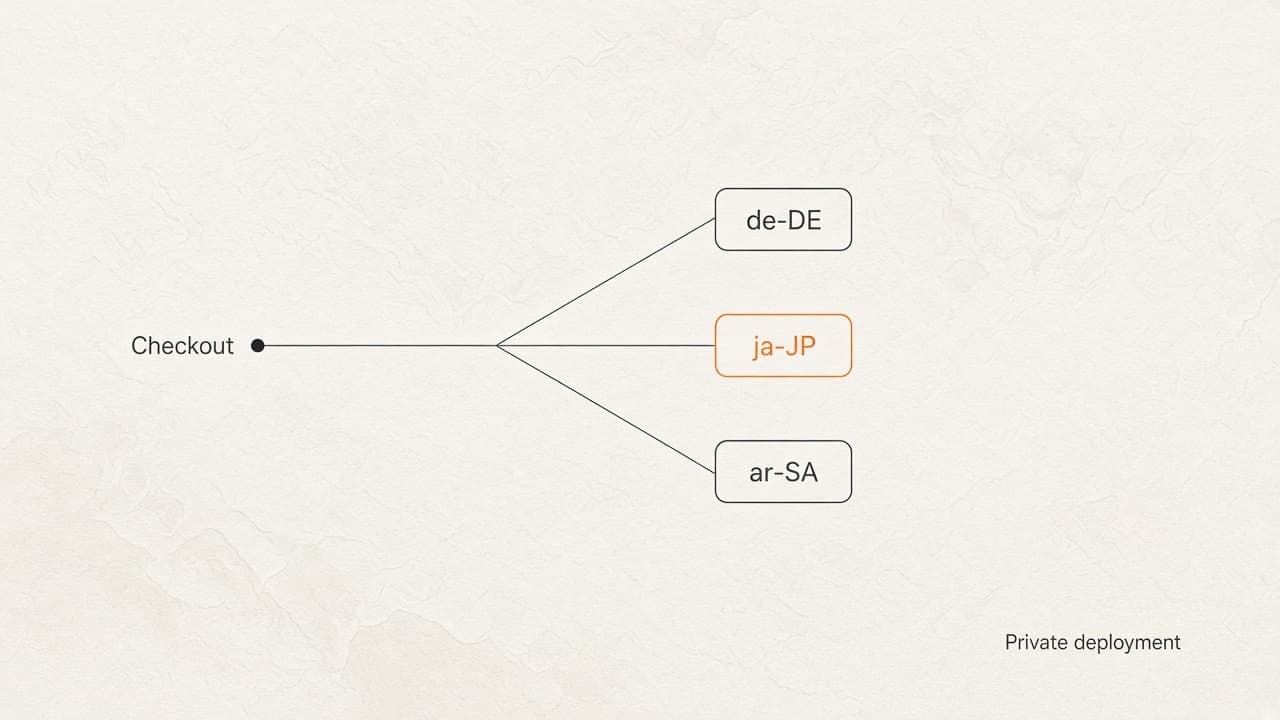
The second organization is the tell
Groups expanding from or into China, the EU, and the US all hear the same promise: one product, many markets. They then staff a second QA motion per region - linguists, agencies, local device labs - because the last mile never lived in the same loop as the English web journey. Expansion adds a cost center instead of revenue.
The useful language is operating, not tooling. Buyers already talk about 质量一致性 (quality consistency), 出海 (going global), 合规 (compliance), and 私有化部署 (private deployment). 测试智能体 is a named category in China-market conversation. None of that requires claiming HarmonyOS, UOS, or 信创 OS coverage you do not ship. It requires the same customer path, walked in the locales you sell, with data residency and a subprocessors list a security team can read.
What “same journeys” actually means
- One intent: the path that must not break in every market you name on the website.
- Environments you actually ship: browser, iOS, Android, desktop - not a cloud farm you do not have.
- Locale as journey coverage: untranslated copy, RTL, truncation, currency and dates.
- Residency and private deployment on request - named subprocessors, not a slogan.
- A readiness reading per release, not a regional slide deck.
IKEA’s Bahrain “Same text but in Arabic” failure, documented as a workflow miss, is the consumer version of the same gap: the file moved; the journey was never walked. For 出海, the gap is larger because payment, identity, and layout all change with the market. CISQ-scale cost is the US frame; missed TAM is the board frame.
What this is not
Do not imply 信创 OS coverage. Do not lead with Selenium. Do not sell a TMS. Do imply: the same journeys, validated for the locales you sell into, with an agent security can procure because it asks for a lane instead of bypassing controls. Private deployment is a conversation on the walkthrough, not a fake badge.
Related insights