Insights/Operations · September 16, 2026
Coding agents created a release-confidence gap
Why validation is now the scarce resource. Teams can generate a week of work in an afternoon. They still spend the week asking whether the product actually works.
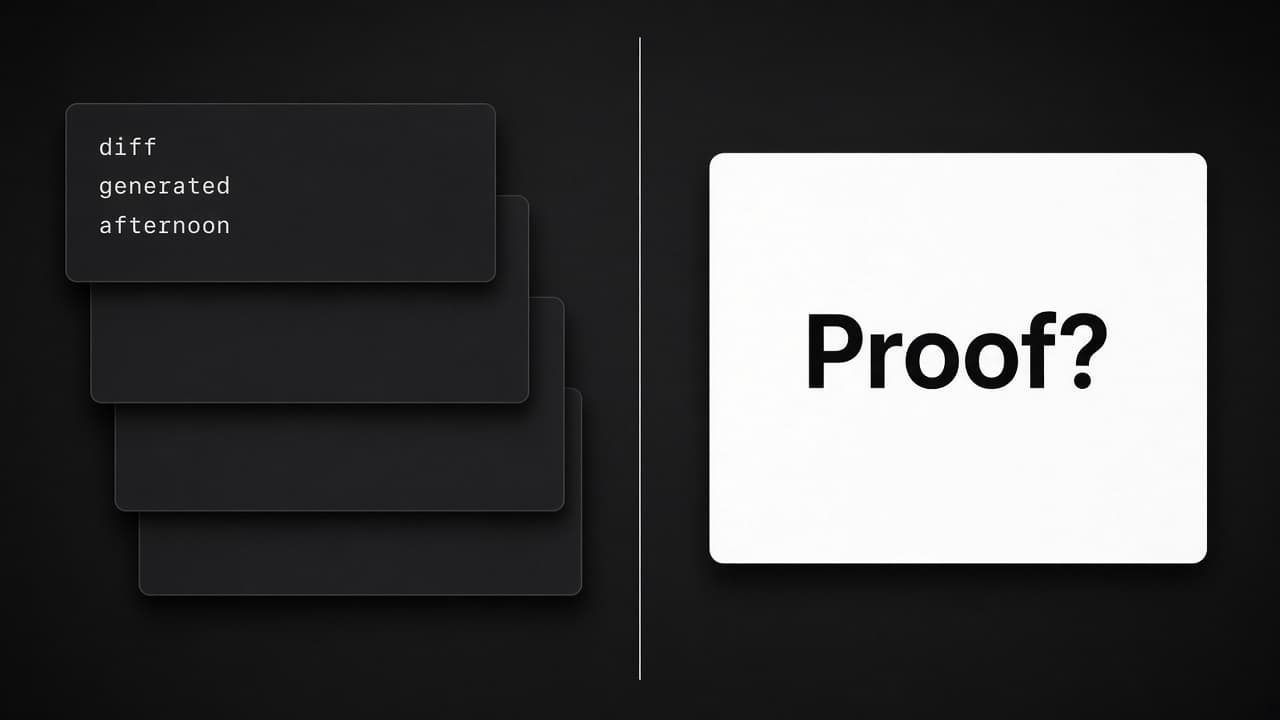
Output outran validation
Engineering got faster. Release confidence did not. A product team can now generate a candidate in the time it used to take to argue about a ticket. The bottleneck moved. It is no longer “can we build it?” It is “do we know it is safe to release?”
That gap is not a staffing anecdote. It is the same mechanism the industry is already measuring on the delivery side. DORA’s four keys separate deployment frequency and lead time from change-fail rate and time-to-restore. Coding agents pull the first pair forward. They leave the second pair untouched unless someone walks the actual customer path.
The pattern showed up in public as soon as generation scaled. QA Wolf’s argument on “code factories” is useful even if you do not buy their model: generation capacity went up; verification capacity did not. Suites, checklists, and weekend warriors do not compound the way agents do. They lag the product, then they get overridden.
Coverage is not a ship decision
A wall of green checks can still miss the journey. Checkout can “pass” while a discount breaks payment. A confirmation can never appear. A CTA can be unusable on a phone. A form can be unreachable from the keyboard. A Japanese or Arabic screen can still be in English. Those are not test-count problems. They are experience issues that dashboards miss.
When the suite is treated as inventory - scripts, selectors, retries, quarantines - it becomes an unowned production system. People stop believing it. They ship around it. Quality becomes an operations problem: war rooms, rollbacks, credits, and a meeting that still has to invent a go / no-go from Slack threads.
What has to sit after the PR
The Cursor analog for shipping is simple: intent in, autonomous execution out. Coding agents sit on the build side. The teammate on the other side of the PR has to learn how the product actually works, walk the journeys that matter, and say whether the release is ready.
- Give the agent the product and the intent - a URL or a build, and the journey that must not break.
- Let it learn the experience: screens, navigation, auth boundaries, states - not 500 predefined cases.
- Walk the same journey on web, iOS, Android, and desktop as environments, not as three tools to buy.
- Investigate what was not scripted: unexpected behavior, surrounding flow, impact on the path.
- Return Ready, At risk, or Not ready - matching a real recommendation, not a fake score.
What this is not
This is not a request to throw existing automation away on day one. It is not “the 13th AI testing tool.” It does not ask leadership to buy a test-management console. It asks them to restore proof at the speed of generation - and to treat localization as market coverage, not as a crawler SKU sitting beside the suite.
KaDeep AI is the agent on that side of the PR. You still own the product. The agent is the teammate who walks it before the cut.
Related insights